
Game Overview
- Primary category: Action
- Best for: Browser, Chromebook, No Download
- Quality score: 92/100
- Platform: Browser, no download, Chromebook friendly
- Source host: Classroom6x Mirror
1. HOOK
Two tile boards. One keyboard. The original 2048 asks you to merge numbers on a single grid; this version splits your attention across two of them running at once. Lose track of one side while you optimize the other, and a board fills before you've noticed.
2. WHAT IT IS
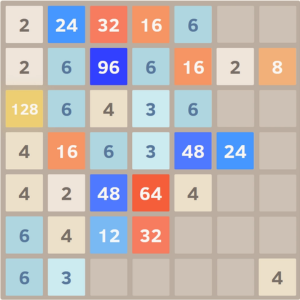
2048 Multitask presents two 4x4 grids side by side. Each grid holds numbered tiles starting at 2. Arrow input slides every tile in the chosen direction, and two tiles of matching value merge into their sum. Both boards respond to the same key press at the same moment.
A new tile spawns on each grid after every valid move. You reach the target tile (2048) to clear a board, and you lose when either grid fills with no possible merges. Because one input drives both grids, an optimal move on the left can be a wasted or harmful move on the right. Score climbs from merge values, and the difficulty curve tightens as time passes and tiles accumulate.
3. HOW TO PLAY
Use the arrow keys to slide tiles. Up, down, left, right — each press shifts both boards in that direction. The mouse handles menus and restarts, nothing more during play.
Here's the mechanic most people miss: a move only counts if at least one tile actually shifts on at least one board. If neither grid changes, no tile spawns and your input is dead. The common beginner mistake is treating the two boards as one problem. You'll mash arrows trying to fix the left grid and quietly choke the right grid into a corner. Keep both in your peripheral vision. Plan moves that help one without wrecking the other.
4. HOW IT DIFFERS
The classic 2048 by Gabriele Cirulli is a solitary optimization puzzle: one board, one strategy, full control over every consequence. Multitask removes that control by forcing a shared input across two independent boards. What was a clean planning exercise becomes a compromise problem, where you constantly trade one grid's health for the other's. The skill shifts from pure pattern building to managing divergence between two states you can't separately command.
The weakness is real and structural. Over a long session the loop flattens — you're still sliding the same tiles toward the same merges, and the dual-board twist doesn't generate enough variety to stay sharp for an hour straight. Marathon runs blur together. The novelty that makes the first ten minutes interesting is the same novelty wearing thin by minute forty.
5. WHO SHOULD SKIP IT
Players who built a corner-stacking strategy in standard 2048 and want to execute it cleanly will resent this. The whole appeal of single-board 2048 is that your plan is yours alone; here, every press betrays one grid to serve the other, and that betrayal is the point. If you get genuinely annoyed when a game prevents you from playing optimally on purpose, this will read as artificial frustration rather than challenge. People who prefer slow, deliberate single-screen puzzles should pass.
6. TIPS
- Pick a "lead" board and a "follow" board for each stretch of moves. Optimize the lead grid's corner stack, and accept whatever damage falls on the follow grid. Switching which board you prioritize every few moves keeps both alive longer than trying to perfect both at once.
- Sometimes make a move that does nothing useful on one board to save the other. A press that only shifts the left grid still spawns a tile there, but it can rescue the right grid from a lockout. This feels wasteful and it isn't.
- Avoid the up and down keys early when both boards are sparse. Horizontal moves tend to keep your high tiles anchored to one side across both grids, which builds parallel structure instead of scattering values. Vertical presses early often split your big tiles apart.
- Watch the fuller board, not the one you're winning. The grid closest to filling is the one that ends your run, so it deserves your input priority even when the other board looks more promising. Defensive play on the losing side beats offensive play on the safe side.
7. COMPATIBILITY & ACCESS
The title runs as one of the standard HTML5 browser games, loading directly in Chrome, Firefox, Edge, or Safari without any download or plugin. No account or installation gates the start screen. As far as unblocked games go, it carries a small footprint and loads on slower connections quickly. Because it's a single lightweight page, it tends to slip past the filters that block heavier sites, making it one of the more reliable browser games for school Chromebook unblocked setups. Mobile support is functional but compromised — touch swipes work, yet running two grids on a phone screen leaves little room for either, so a physical keyboard remains the better choice.
8. FINAL TAKE
This is a stress test bolted onto a math puzzle, and that's exactly why it deserves a slot in any unblocked rotation rather than a permanent install. The dual-board gimmick is thin enough to exhaust in a sitting, but it does something the original never attempts: it punishes tunnel vision directly. Most 2048 clones add cosmetic skins or bigger grids and call it progress. Splitting your attention is a more honest variation than any of them, even if it can't sustain a full afternoon. Worth a few rounds. Not worth a weekend.