
Game Overview
- Primary category: Action
- Best for: Browser, Chromebook, No Download
- Quality score: 92/100
- Platform: Browser, no download, Chromebook friendly
- Source host: Classroom6x Mirror
1. HOOK
Two players. One screen. A countdown ticks, then a basketball minigame drops without warning, and whoever sinks it first scores the point. Seconds later you're dueling with pistols, then dodging falling blocks, then sprinting for a flag. 12 Mini Battles 2 throws a different ruleset at you every round and barely explains any of them.
2. WHAT IT IS
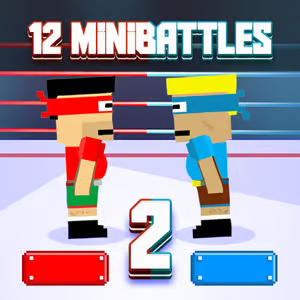
The screen shows two characters on a shared playfield, usually a single static arena per round. Each round pulls from a pool of twelve distinct minigames: shooting, jumping, racing, timing-based clicks, and physics challenges. You control one fighter; a second player or a bot controls the other.
Winning a round earns a point. First to reach the target score takes the match. Losing happens when your opponent hits the goal first, gets the kill, or beats your timing on whatever the current minigame demands. No health bars persist between rounds, and each new game resets the rules entirely.
3. HOW TO PLAY
Player one uses keyboard keys, often A and D or the arrow keys depending on the round. Player two takes the opposite side with mouse or secondary keys. The active controls flash on screen before each minigame begins.
Read that prompt. Most players ignore it and lose the first round of every new minigame just learning what button does what. The non-obvious part: some rounds reward waiting instead of acting, like timing duels where the first to move loses. Don't mash buttons on a reflex challenge before you know if speed even matters. That's the rookie mistake that costs early points.
4. HOW IT DIFFERS
WarioWare built its name on rapid-fire microgames, each lasting a few seconds, fed to you in escalating sequence by a single player. 12 Mini Battles 2 borrows that variety-pack structure but bolts it onto local two-player competition. Instead of surviving a solo gauntlet, you're winning head-to-head against someone sharing your keyboard, and each minigame runs long enough to matter as a duel rather than a blink.
The weakness is plain. Across a long marathon session, the loop wears thin because the twelve minigames repeat with no new variations layered in. After an hour, you've seen every trick the basketball round and the shooting round have to offer. The difficulty scaling adds speed, not fresh ideas, so the experience flattens once you've mastered the pool.
5. WHO SHOULD SKIP IT
Anyone who only plays alone should look elsewhere first. The bot opponent works, but the design clearly assumes a friend on the other set of keys, and solo play exposes how thin some rounds feel. If you get genuinely angry losing a coin-flip timing duel to a friend who guessed right, this will sour fast — there's real randomness baked into who wins certain rounds, and no amount of skill erases it completely. Competitive players who need every loss to feel earned will resent that.
6. TIPS
- Memorize which minigames favor patience over speed. The timing duels punish early movement, so train yourself to hold still even when your instinct screams to act. That restraint wins more rounds than fast fingers do.
- Watch your opponent's hands, not the screen, in local play. You'll often spot a buttonmash or a hesitation before it shows up in the game itself. Reading the person beats reading the pixels in close rounds.
- Lose the first round of any unfamiliar minigame on purpose by experimenting with the controls. Spending one point to learn the exact input timing pays off across every later round of that same game. It feels backwards, but the knowledge compounds.
- Keep sessions short to dodge the repetition trap. Three or four matches stay sharp; the tenth in a row blurs together. Stopping while you still want more keeps each round feeling distinct.
7. COMPATIBILITY & ACCESS
The title runs in any modern browser without installation, making it one of the simpler free online games to launch on a slow machine. Chrome, Firefox, and Edge all handle it, and you can play browser games without download steps or account creation getting in the way. Performance stays light because the visuals are minimal and the arenas don't move much.
Mobile support is shaky. The two-player layout assumes a full keyboard, so touchscreens struggle to map both control sets at once, and you're better off on a laptop or desktop. Because it loads from a single web page with no heavy backend, it tends to slip through filters on school or office connections where unblocked games are the only thing that loads. Connectivity needs are low, so a weak network won't break it.
8. FINAL TAKE
12 Mini Battles 2 isn't trying to be a deep game, and it shouldn't be judged like one. Its real value lives in the five minutes between two people who happen to share a keyboard, where the randomness becomes a feature instead of a flaw because nobody expects fairness from a coin flip. Solo, it's a curiosity that empties out quickly; with a friend, it's a reliable spark for a quick rivalry that doesn't demand commitment. The repetition that kills it in marathon sessions barely registers in short bursts, which is exactly how it deserves to be played. Few browser games understand their own shelf life this honestly.
Grab a friend, play three rounds, walk away.