
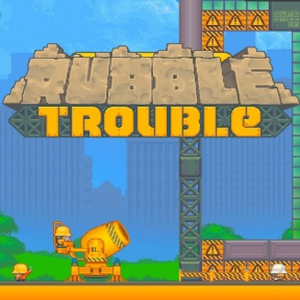
Game Overview
- Primary category: Action
- Best for: Browser, Chromebook, No Download
- Quality score: 92/100
- Platform: Browser, no download, Chromebook friendly
- Source host: Classroom6x Mirror
1. HOOK
Your first move in Rubble Trouble will be a mistake. The hammer swings, the rubble block pings off the wall, and the combo counter resets to zero. You'll learn, but the game won't wait. Three more blocks are already falling.
2. WHAT IT IS
A hammer sits at the screen bottom. Rubble blocks descend from the top. Each block shows a number: its remaining durability. The player moves the hammer horizontally. A swing destroys a block when its durability reaches zero. A block reaching the bottom undamaged costs a life. It ends when no lives remain.
Blocks arrive in waves. Over time, speed and numbers increase. The screen is static: no scrolling, no side areas. Visual feedback is limited to a combo multiplier and a score counter in the top-right corner. No narrative context is provided. No characters speak. The soundtrack is a loop of percussive hits that sync with block impacts.
3. HOW TO PLAY
You see a hammer at the bottom. Blocks fall from the top. Use mouse or arrow keys to move the hammer. Click or press Space to swing. The swing connects when hammer and block overlap. That block loses one durability. At zero durability, the block shatters and awards points.
Timing matters more than speed. Swing too early and you'll miss. Swing too late and the block passes. A hidden mechanic: edge strikes deal bonus damage. Most players miss this because the visual cue is subtle: a faint spark on contact. Beginners also misuse the charge function. Holding the swing button for 0.3 seconds releases a charged strike that destroys any block in one hit. But holding too long cancels the charge, leaving you vulnerable. The common mistake is tapping erratically when blocks cluster. That triggers a cooldown between swings, causing missed blocks.
4. HOW IT DIFFERS
Breakout popularized the paddle-and-ball format in 1976. A ball ricochets off a paddle, chipping away at bricks. Trajectory depends on where the ball hits the paddle. Rubble Trouble inverts the relationship. Instead of launching a projectile, the player swings a hammer directly at descending blocks. There is no ball, no ricochet (except block-on-block), and the paddle is a hammer striking at variable angles. Blocks are active threats: they fall and can end the game, rather than passively waiting.
That inversion changes the pace. Breakout rewards sustained precision. Rubble Trouble demands burst precision. The weakness emerges after 20 minutes. Falling patterns repeat with minor variations; no level variety or power-ups flatten the loop. Long sessions reveal limited enemy behavior. It never introduces new mechanics; it just accelerates, which is not the same as evolving. It's a loop designed for short, intense sessions, not marathon runs.
5. WHO SHOULD SKIP IT
Players who need progress beyond a high score will bounce off Rubble Trouble. There are no unlocks, no story beats, no character upgrades. If you measure a game by hour-to-hour change, this one feels like a wall. Its arc is internal: your timing improves, but the screen remains identical from minute one to minute sixty. If you alt-tab when a game stops introducing new elements, this isn't for you. It will outlast your interest.
6. TIPS
- Angle the hammer for edge strikes. Edge hits deal 50% extra damage and splash to adjacent blocks. It's the fastest way to clear dense clusters.
- Don't charge every swing. The charge immobilizes you. Use charged swings only on high-durability blocks with a clear path. Otherwise, rapid swings keep the field clean.
- Let the first block hit the ground. It costs a life, but invulnerability frames let you reposition freely. Then line up edge strikes on the rest. This trade-off is never explained in-game.
- Position the hammer slightly off-center at the start. Most players center it, but blocks favor a 60/40 screen split. That bias is consistent across sessions.
7. COMPATIBILITY & ACCESS
Rubble Trouble runs in any modern browser with HTML5 and WebGL support. No download or plugin is required. It loads directly on sites that host free online games. Mobile support is limited. Touch controls exist but lack the precision of a mouse or keyboard. On a phone, the hammer lags behind your finger, and edge hits become unreliable. For the full experience, a desktop with a physical mouse is recommended.
It's often available on unblocked game lists, making it accessible on school or office networks. Because it requires no installation, you can play browser games without download instantly. As with many free online games, expect ad banners around the play area. These can be closed after a few seconds. It does not serve ads during play.
8. FINAL TAKE
Browser gaming has a graveyard of block-breakers. Most innovate with power-ups or physics. Rubble Trouble strips the genre to a single verb: swing. That minimalism is its edge. It loads fast, demands nothing, and ends when you close the tab. In a landscape of bloated free-to-play titles, a game that respects your time by being unambitious is refreshing.
Rubble Trouble won't change how you think about games. But it might change how you spend your 15-minute breaks. That's enough.